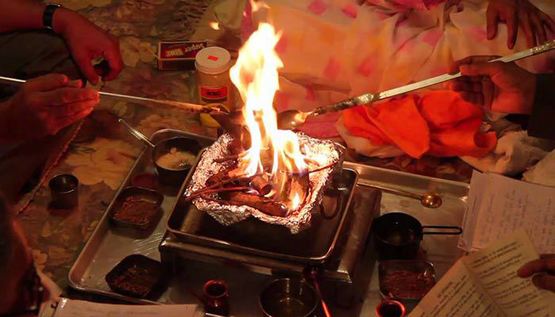
Agni-hotra is an integral part of the Vedic Heritage. Literally, Agni-hotra is the sacrificial fire, which is of three kinds: Gaarhapatya, Aahavaniya and Dakshina. The Vedas stand for the true knowledge, both physical and transcendental. The Vedic teachings are based on the intuition of the man, who meditated upon the Truth or Absolute to know what Paramaatman, Jivatman and Prakriti mean. Therefore the Vedas are said to be the guideline for Dharma, Artha, Kaama and Moksha, which can be attained through Purushartha and Praarabhdha. Purushartha stands for the actions based on morality, ethics and religious obligations.
In other words, Purushartha is based upon human actions associated with the will power. Praarabhdha is the fruits of our actions, which we are destined to have as a result of the actions we do in daily life. Every action corresponds to its fruit, i.e. equal and opposite reaction. Therefore, if we long for the serene life from today, we must go in for right actions, right deeds and right thoughts. The Agni-hotra is a way, which leads us to attain the highest. That highest is the attainment of Ishwara — to realize the Divinity in and around, both immanent and transcendent.
Agni-hotra has its spiritual and materialistic values. It elevates our Spirit, lifts us from physical understanding to the blissful state of mind. It is a step by step approach to reach the highest dawn, from man to Rishi. It is the very concept of sat-chit-anand, or Truth, Consciousness and Bliss. Etymologically, if we analyze the word Agni, it is the combination of A (aa), G (ga), N (na), and I (ee). A stands for the Immutable Lord Parmeshwara. Akaar is Vishnu.